


.svg)

Integrate
Xero
With Workhorse
Two-way Xero integration: invoices, credit notes and purchase orders post in real time, coded to your accounts, and payment status flows back. Nothing to re-key in Xero.
How Workhorse works with Xero
Workhorse runs the operational side of the business — orders, stock, purchasing, production and despatch — and Xero keeps the financial record. The integration connects the two so every transaction is entered once, in Workhorse, and arrives in Xero ready for your bookkeeper: correctly coded, at the status you’ve chosen, with nothing to re-key or correct.
What syncs
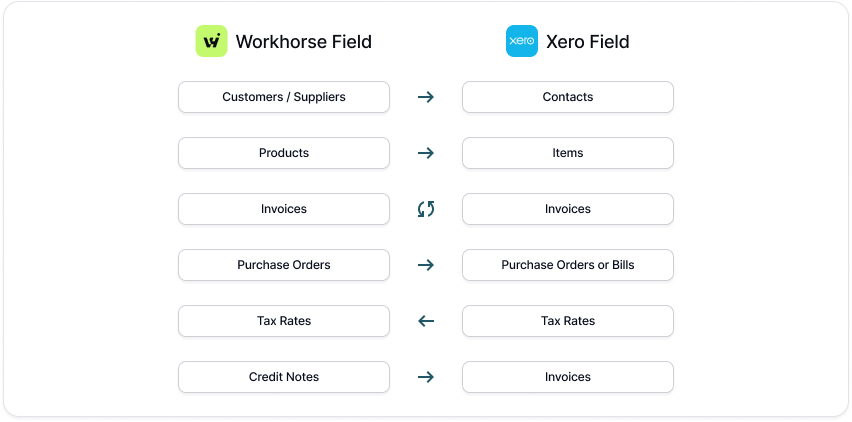
- Invoices — Workhorse to Xero, in real time, when the invoice is set to Sent.
- Credit notes — Workhorse to Xero when set to Sent.
- Purchase orders — Workhorse to Xero, arriving as purchase orders or as bills — your choice, set once in configuration.
- Customers & suppliers — posted to Xero as contacts.
- Payment status — Xero to Workhorse: invoices and credits are marked paid or part-paid from Xero after reconciliation, with the amounts — updated automatically overnight, or on request when you want it now.
- Tax rates — Xero to Workhorse, so every line uses your Xero tax codes.
- Chart of accounts & tracking categories — Xero to Workhorse, so postings arrive coded to your accounts and, where you use them, your tracking categories.
- Products — Workhorse to Xero as items.
The full field mappings, record by record, are in the setup guide below.
Posted how you want, when you want
The integration is configured like the rest of Workhorse. You choose which accounts invoices, purchases and stock adjustments post to, whether invoices arrive in Xero as draft, awaiting approval or awaiting payment, and whether purchase orders arrive as purchase orders or bills — set once, to match how your Xero is already run. From then on, transactions land correctly coded at the right status: your bookkeeper reconciles them, and there’s nothing to re-code. And like the rest of the platform, the integration can be customised where your accounting treatment genuinely needs it — scoped and built the same way as any other development. How that works is set out on configuration & customisation.
Stock, COGS and month-end
Workhorse is the stock record; Xero is the financial record. We recommend products in Xero are left untracked — Workhorse tracks quantities, locations, batches and values, so there’s no second stock system to maintain. Cost of goods sold is posted as a month-end journal using a dedicated Workhorse report that values the period’s movements: one journal a month, and Xero stays clean in between. Posting COGS per transaction is also supported — few of our customers use it, because of the work it creates in Xero — but where an in-month balance sheet matters, we can set it up that way.
What the integration doesn’t do
Some things don’t sync as standard: invoices and credit notes don’t flow from Xero into Workhorse (their payment status does), purchase orders and bills don’t either, and purchase order and bill payments don’t sync back. Those are the boundaries of the standard integration. Where a business has genuinely needed more, customisation has covered it: for one customer the integration fetches purchase orders from Xero; for another it creates sales orders from Xero invoices. If your workflow needs something similar, ask us at the discovery call.
The integration is connected and configured during your managed implementation — this guide is the reference for how each setting works and what syncs where.
One: Data Flows
Benefit from the full power of Workhorse and cut down on your double-keying by integrating your Xero account with your Workhorse system
Two: How to connect
In order to access the integrations setting you will need to have full access to the settings in the system.
To integrate Workhorse with Xero, navigate to Settings in the left hand menu and select Integrations. Then select “Add New” from the top right of the screen. The integrations screen will appear with Integrations on the left hand side and Additional Information on the right hand side. First, use the Integrations box to connect Xero.

The fields on the left hand box are:
- Name Select Xero
- Active This will default to a “x” and turn into a tick when you have connected the applications.
- Expire Defaults to blank. This will show your Xero expiry date once you have connected the applications.
- Connection Detail This will show the instance of Xero that you are connected to.
All you need to do is select Xero and then select Functions/Connect to connect the systems.

Three: Configuring the integration
Now you need to configure the integration using the right hand box “Additional Information”.
Below is the Additional Information section in Workhorse:
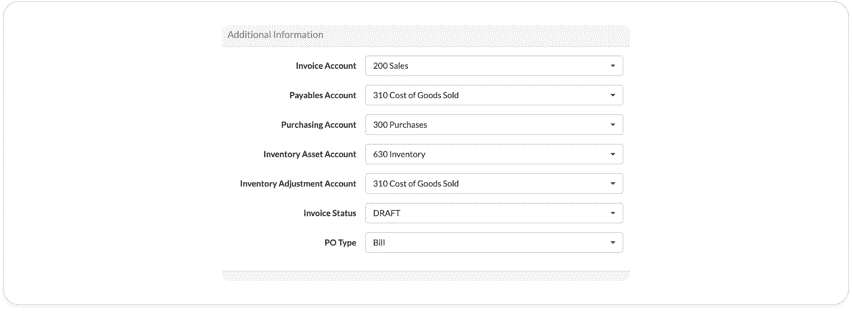
The Additional Information fields on the right hand side enable you to configure how and where your data will appear in Xero. The above screenshot shows the configuration that we would recommend if you haven’t used Xero before.
Invoice Account
The account to which Invoices with the Workhorse status “Sent” will be posted in Xero. Choose from the following options:
- 200 Sales
- 260 Other Revenue
- 270 Interest Income
If you haven’t used Xero before, we suggest setting this to “200 Sales”, otherwise, use the account you are currently using in Xero.
In the screenshot below you can see that the Invoice Account from Workhorse displays as the Sales Account on a Product in Xero, the Purchasing Account displays as the Cost of Goods Sold Account and the Inventory Asset Account displays as the Inventory Asset Account.
Screenshot of a Product in Xero:

Payables Account
The account to which bills with the Workhorse status “Sent” will be posted in Xero — purchase orders post to the separate Purchases Account. Choose from 38 options including General Expenses, Cost of Goods Sold and other more specific options. If you haven’t used Xero before, we suggest “310 Cost of Goods Sold”; otherwise, use the account you are currently using in Xero.
Purchases Account
The account purchase orders are posted to in Xero — bills post to the separate Payables Account above. The options are the same Xero expense and cost-of-sales accounts listed for the Payables Account. If you haven’t used Xero before, we suggest “300 Purchases”; otherwise, use the account you currently use for purchases in Xero.
Inventory Asset Account
When you first create a stock adjustment in Workhorse, your adjustment will create a dummy Supplier in Xero called “Inventory Adjustment”. All stock adjustments will be posted to this supplier and to the Inventory Asset Account you choose in this field. Choose from 18 options including 630 Inventory and other more specific options. If you haven’t used Xero before, we suggest setting this to “630 Inventory” otherwise, use the account you are currently using in Xero.
Inventory Adjustment Account
Stock adjustments will use the account chosen here as the account that payment comes from. Same options as Payable Account above. If you haven’t used Xero before, we suggest setting this to “310 Cost of Goods Sold” otherwise, use the account you are currently using in Xero.
Invoice Status
This is the status which will show on your invoices when they get posted to Xero. They are passed to Xero when you select the status “Sent” in Workhorse.
Choose from the following options:
- Draft: Draft in Xero
- Submitted: Awaiting Approval in Xero
- Authorised: Awaiting Payment in Xero
If you are new to Xero we suggest you use the “Draft” option.
PO Type
Choose from the following options:
- Bill or
- Purchase Order
If you are new to Xero we suggest you select the Bill option. If you already use Purchase Orders in Xero then select this option.
Four: How different fields and records sync
Tax Rates (Xero to Workhorse only)
To sync the tax rates from Xero to Workhorse, simply go to Settings/Tax Rates and select the function “Sync Xero Tax Rates” from the top right hand side of the page. You will then be able to see and use all the Xero tax rates in Workhorse:

Xero contains the full range of Taxes for a UK based company. The fields which correspond in Workhorse and Xero are:

Customers & Suppliers
Customers and Suppliers in Workhorse correspond to Contacts in Xero.
While we can initially pull customers and suppliers from Xero, our standard process is to post them to Xero. Following the initial sync, we no longer pull customers or suppliers from Xero.
Data is not automatically pulled from Xero, it is posted to Xero. If you need to update an address, you must do so in Workhorse. Re-saving the record in Workhorse will then post the updated details to Xero.
Workhorse to Xero
When you add a Customer in Workhorse and save the record they become a contact in Xero.
- If you add an invoice for that customer/contact they then become a Customer in Xero and the invoice posts to Xero when you save it at the status “Sent”. When you add a Supplier in Workhorse and save the record they become a contact in Xero.
- If you add a Purchase Order for that Supplier/contact they then become a Supplier in Xero when you save the Purchase Order to the status “Sent”.
Xero to Workhorse
When you add a contact in Xero they are contacts until such point as you have added a purchase order, bill or invoice for them.
- Xero Contacts become customers in Workhorse when you add an invoice for them at Draft status in Xero.
- Xero Contacts become suppliers in Workhorse when you add a bill or purchase order (depending on the setting in config in Workhorse) at Draft in Xero.
- Note you will need to choose to add either Purchase Orders OR Bills in Xero and configure Workhorse to match what you are using. If you add a purchase of the wrong type, it will not add the supplier to Workhorse.
In order to sync Xero customers to Workhorse, navigate to the Customers Menu in Workhorse and select functions, Sync Xero Customers. All of your customers from Xero will now be available in Workhorse.

There is a similar function in the Suppliers screen of Workhorse which syncs Xero Suppliers to Workhorse:

These are the fields that sync between Workhorse and Xero:
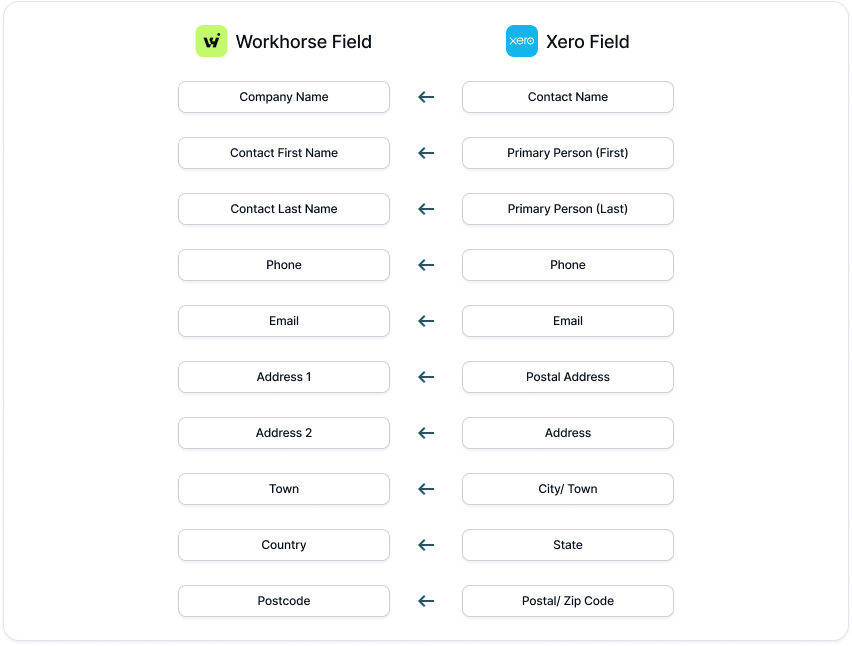
Note that contacts in Xero who don’t have Purchase Orders, Bills or Invoices against them in Xero will not have a customer or supplier status and so won’t pull through to Workhorse. Customers and suppliers in Workhorse without Purchase Orders associated with them will sync to Xero as contacts.
Products
It is possible to sync products held in Workhorse to Xero. When you add a product to Workhorse and save it, you will see that the Xero reference populates.

This creates an item in Xero and you will now be able in Xero to create an invoice and pick this item from the drop down “Item” in the “New Invoice” screen.
The corresponding fields in Workhorse and Xero are:

If when you set up the link to Xero, you already have some products saved in Workhorse, you can still sync them to Xero. Simply go to the product record of each product and click save and you’ll see the Xero reference populate.
Note: If you add an invoice for a product that is in Workhorse, but not in Xero the invoice will not save to Xero and you will see an invalid product error. You will then need to add the product to Xero by re-saving it in Workhorse. Ideally, you will want to sync all products to Xero first by saving them.
Invoices (Workhorse to Xero)
When you add an invoice in Workhorse, it will automatically sync to Xero when you set the status of the invoice to “Sent” and Save it. You will see a Xero reference in the Workhorse record and you will be able to view that invoice in Xero.
Xero to Workhorse
Invoices do not flow from Xero to Workhorse however the sync function pulls back the payment status on the invoice from Xero for Workhorse invoices which have already been interfaced to Xero. Sync open invoices looks for payments for any invoices in Workhorse that aren’t already marked as paid and marks them as paid or part paid in Workhorse. The amount Paid in Xero will also pull through to the Workhorse Invoices Total Paid field.
To sync the statuses from Xero use the “Sync Xero Open Invoices” function at the top of the Invoices screen:
The fields which correspond in Workhorse and Xero are:

Credit note (Workhorse to Xero)
Credit notes sync to Xero from Workhorse when they are at status “Sent”. They appear as invoices in Xero with the status “Draft”.
Xero to Workhorse
Credits do not flow from Xero to Workhorse however the sync invoice function pulls back the payment status on the credit from Xero for Workhorse credits which have already been interfaced to Xero. Sync open invoices looks for payments for any credits in Workhorse that aren’t already marked as paid and marks them as paid or part paid in Workhorse. The amount Paid in Xero will also pull through to the Workhorse Credits Total Paid field.
Credits are now only marked as Complete by Workhorse when they have been fully paid in Xero or marked as fully paid in Workhorse.

The fields which correspond in Workhorse and Xero are:

Purchase Order
Purchase Orders in Workhorse sync to either Purchase Orders or Bills in Xero. This is configured by the “PO Type” setting on the initial Configuration screen.
Workhorse to Xero
Purchase orders sync to Xero when they are set to Status “Sent” in Workhorse. Purchase orders and bills do not sync from Xero to Workhorse.
The fields which correspond in Workhorse and Xero are:

Xero also has useful documentation on importing data to their system from Workhorse. https://central.xero.com/s/article/Import-data-in-to-Xero
Five: Frequently Asked Questions
How do I disconnect from Xero?
You can disconnect from Xero by selecting the functions button on the Configuration page and selecting Disconnect. This will mean that data will not flow between the two software but that all data that you have at the time that you make the disconnection will remain.
What doesn’t your integration do?
As standard, invoices and credit notes don’t flow from Xero into Workhorse (their payment status does), purchase orders and bills don’t either, and purchase order and bill payments don’t sync back. The field-mapping tables above show exactly what syncs for each record type, and the About tab covers where customisation has extended this.
Should we use Xero’s tracked inventory alongside Workhorse?
We recommend not — products in Xero are left untracked. Workhorse is the stock record, tracking quantities, locations, batches and values, so tracked inventory in Xero would be a second stock system to keep in step. Xero holds the financial record.
How does cost of goods sold get into Xero?
As a month-end journal for most of our customers, posted from a dedicated Workhorse report that values the period’s stock movements — day to day, invoices and bills arrive coded to your accounts, and stock value is trued up once a month in one journal. Posting COGS per transaction is also supported; few customers use it, because of the work it creates in Xero, but where an in-month balance sheet matters, we can set it up that way.
When and how does data sync occur?
Syncing from Workhorse to Xero happens in real time when you save a record at the correct status. For example when you save an invoice at status “Sent” you will instantly see that record in Xero.
Updates from Xero to Workhorse run automatically overnight, and can also be triggered on request from the relevant screen — for example “Sync Xero Open Invoices” at the top of the Invoices screen.
You will know that a record has synced from Workhorse to Xero because it will be given a Xero reference. This will display at the bottom of the Workhorse record, above the “Save” button:

Set up for you, supported after
The integration is connected and configured during your managed implementation. Our team sets the accounts and statuses with you, confirms the connection before go-live, and checks the first transactions come through as they should. After go-live, the helpdesk takes over. Questions answered, and small changes included in the ongoing service.

If you're an accountant or bookkeeper assessing Workhorse for a client, book a call and bring the client's Xero setup — we'll walk through exactly what would post where.

Start a live chat
Speak to our friendly team via live chat

Email us
hello@goworkhorse.com

Call our team Mon-Fri from 9am to 5pm
+44 (0) 808 284 0016
Related Integrations

Stripe

QuickBooks
Ready to get control of stock, orders and fulfilment?
Get started today and see the difference Workhorse can make for your business.