

Batch production & traceability
For businesses where every unit belongs to a batch, every batch carries a date — and the record has to hold in both directions.

This page is for producers and handlers of products with obligations attached: food and drink producers — from tea and chocolate to wine and premixed cocktails — honey sold under certification, seed and ingredient businesses, and chemicals. In these businesses stock isn’t a single quantity on a shelf — it’s batches, each with a number, a date and a history — and a certifier, an auditor or a customer’s technical team expects that history on request. Standard stock records hold a quantity per product. These businesses need a record per batch, and software that tracks batches rather than just totals.
Twelve pallets, four batches, three dates
A drinks producer's twelve pallets of finished stock are really four bottling runs with three different best-before dates.
What can actually ship depends on the batch: the oldest date goes first, and one retailer requires a minimum remaining shelf life.
A total quantity on hand answers neither question — stock has to be held, allocated and picked at batch level, with the dates driving the order.

If your team checks dates on the shelf because the system only knows the total, this will be familiar.
Inputs in, deliveries out
A tea blender’s single batch draws leaf from several supplier lots. Full traceability means the batch record holds which lots went in — captured at goods-in and through production — and the despatch record holds which customers the batch went out to.
Certification schemes ask the same of honey: provenance at lot level, both ways. And production is often more than one stage — ingredient lots blended into a bulk batch, the bulk batch bottled into finished runs — so the trace has to chain through the intermediate batch. When any link in that chain lives in the goods-in book, a production sheet or a folder of delivery notes, the trace is a reconstruction, not a record.
If tracing one batch means opening three systems and a lever-arch file, that’s the gap.
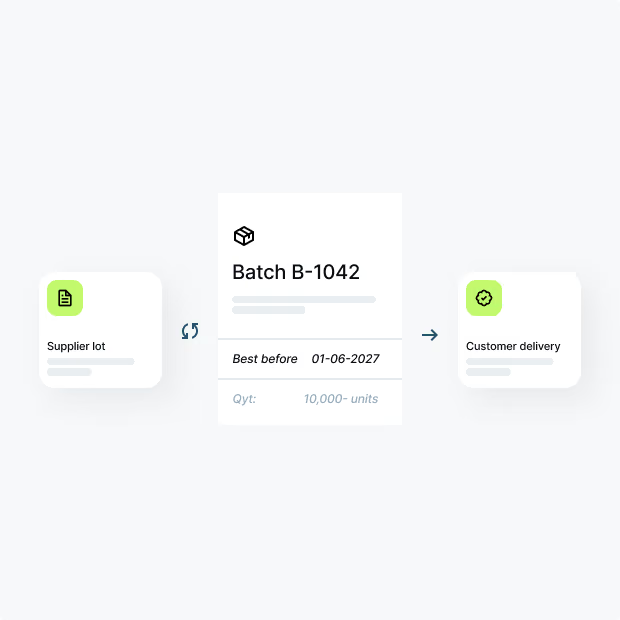
The audit and the recall ask the same question at different speeds
An auditor’s traceability exercise gives you a day: pick a batch, show everything that went into it and everywhere it went. A recall asks the same question with hours. When an ingredient supplier flags a problem lot, a food producer needs to know which of its batches used that lot and which customers received them — before it can even scope the problem, let alone respond.
A hand-built answer arrives slower and less certain at the moment it needs to come straight from a system.
If the last traceability exercise took the whole afternoon, the gap is already showing.
The batch is the record
In Workhorse, batches enter at goods-in with their supplier lot numbers and dates. Production consumes them through the bill of materials — through as many stages as it takes, ingredient lots into a bulk batch, the bulk batch into finished runs — and every batch at every stage records what it drew from.
Stock is held, allocated and picked at batch level with dates visible — oldest first, minimum-life rules respected — and despatch records which customer received which batch. The two-way trace, supplier lot to customer delivery, becomes a report you run in minutes.

Every Workhorse system starts as the complete platform
quotes, sales orders, stock, purchasing, work orders, despatch, invoicing and reporting — and is configured to your obligations during a managed implementation: your batch numbering, your date rules, the reports your certifier or auditor actually asks for. Where a scheme demands something unusual, we build for it. How that works is set out on our configuration & customisation page.
Standard stock systems hold one quantity per product. Your stock is batches — each with a number, a date and a history that has to hold in both directions. Workhorse is built around the batch as the record, so the auditor's question is answered from the system, not reconstructed around it.
"Reporting is detailed and insightful, helping us make better, data-driven decisions."
- Levent Kaya, Head of Operations - Rainbow
Read their stories on our customers page. We also have a dedicated food & drink page.
If your products are shelf-stable, uncertified and sold without lot obligations, batch control is weight you don't need
Our wholesale & distribution page describes your operation better. It's when the auditor's question has to be answered from the system that batch-level control earns its keep.
Bring us your last traceability exercise
The batch it picked and the records it needed — and we’ll show you how Workhorse answers it in both directions, from supplier lot to customer delivery.